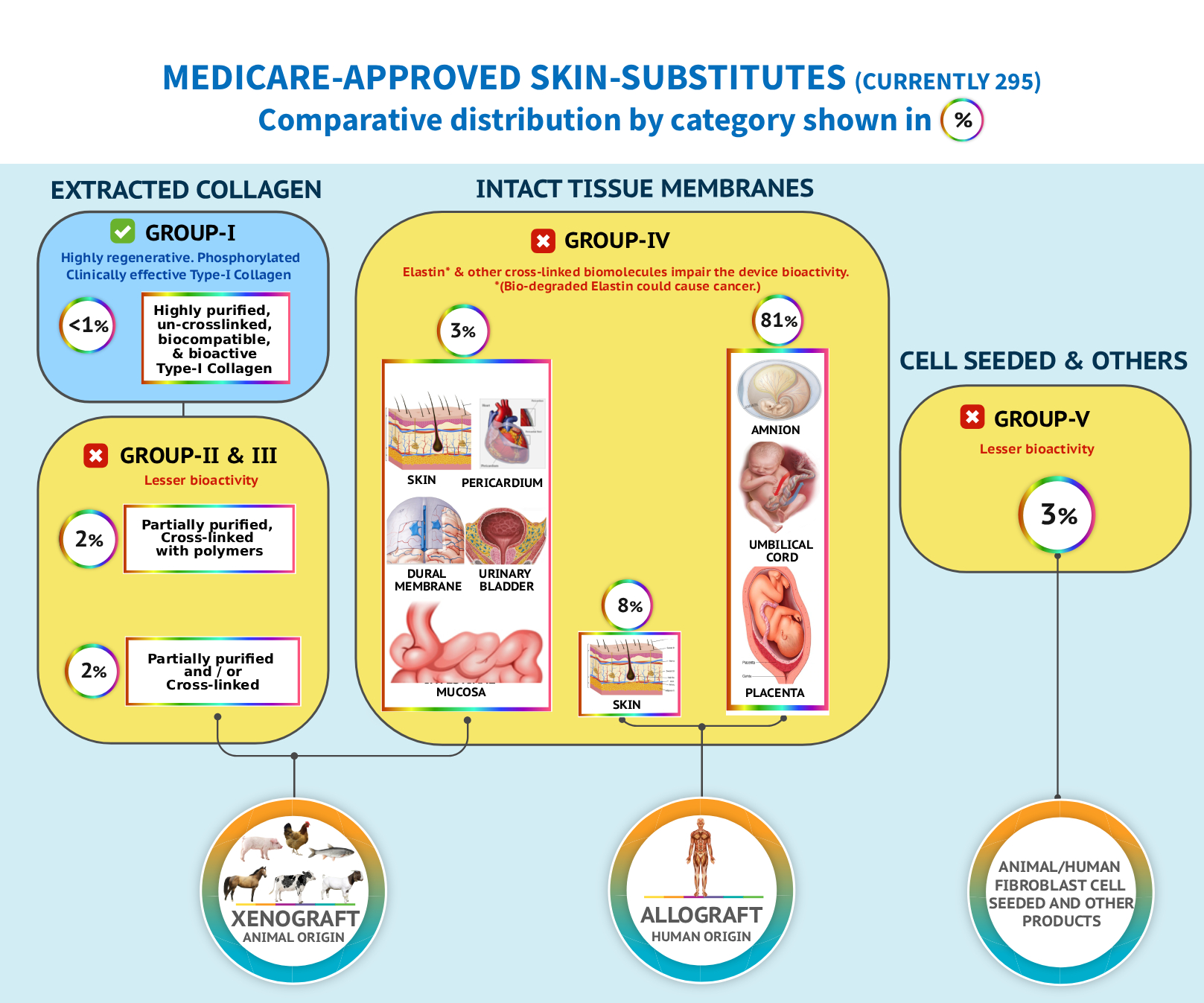
This post is to create an awareness of different categories of Medicare-approved skin-substitute products (approx.295) in the market.
Most of these products are derived from intact tissues of either Allograft (amnion related – 81%, skin – 8%) or Xenograft (intestine, skin, pericardium, urinary bladder, dura – 3%). All cryopreserved skin allografts do cost more, have short shelf-life, difficult to sterilize and store. Despite the assurance that the cells are removed, they must contain a significant amount of Elastin, Type-III Collagen and other immunogenic proteins. Thereby, such products may have to be compulsively cross-linked to reduce their immunogenicity. This process restrains the bio- effectiveness of the useful Type-I collagen.
The next group of lesser numbered products is Xenograft extracted-collagen. Most such products (2%) may not be pure type-I collagen under patented process. They also might face the same terminal disadvantages explained earlier. Polymer added cross-linked collagen products (2%) may not uplift its bio-effectiveness either. There may be some claims of highly purified un-cross linked extracted collagen membrane products (1%) to be focused on.